
SEO Overview metrics
Canonical metric definitions for SEO Overview. In-product help deep-links to `/help/knowledge-base/metrics/seo/seo-overview`.
Canonical definitions for SEO Overview (search-context performance for the selected date range). In-product help deep-links to /help/knowledge-base/metrics/seo/seo-overview.
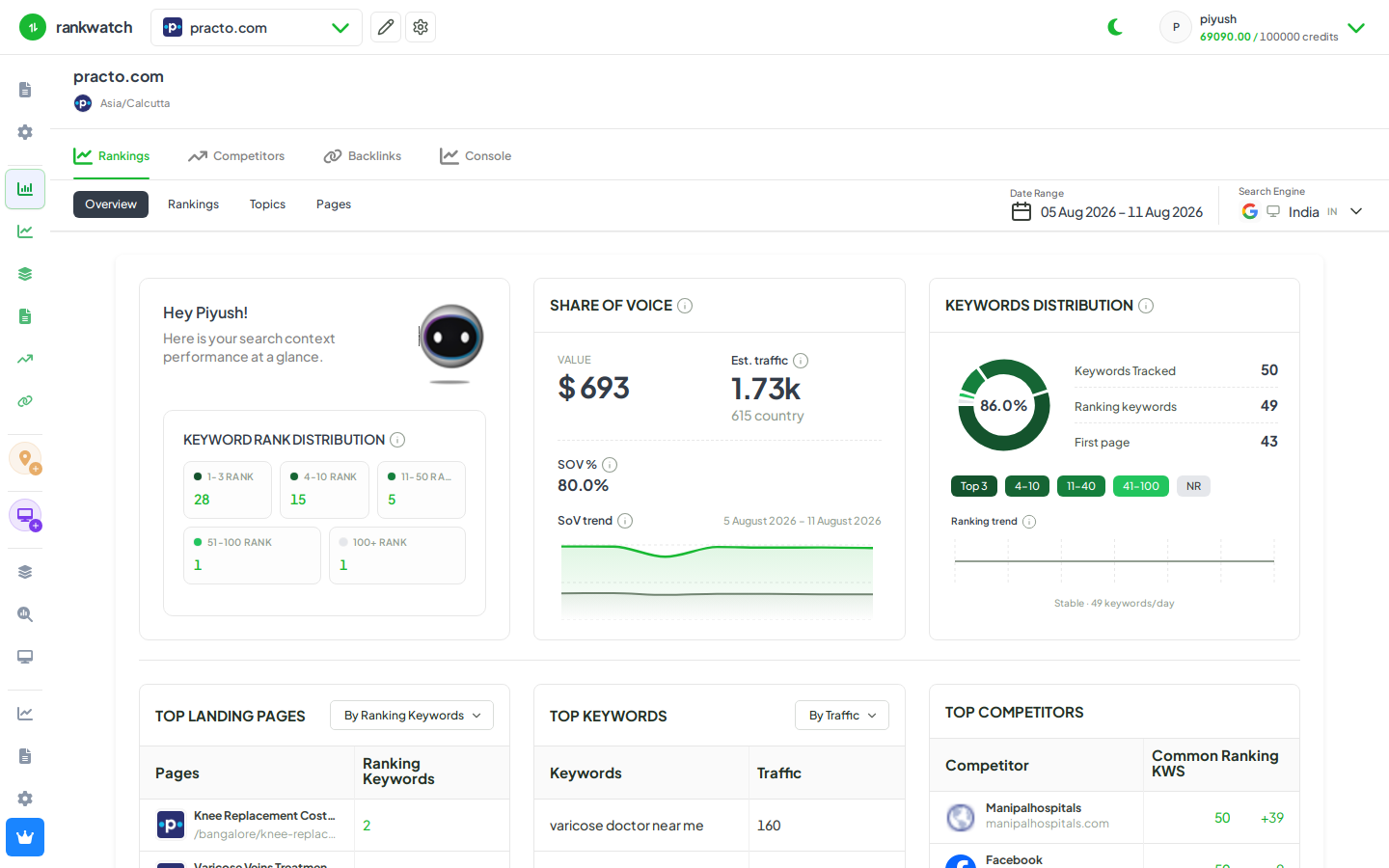
UI surface
Open /projects/:id/search/:contextId (or the multi-engine overview when several contexts are selected).
A range of 4 days or more is a period dashboard: visibility trend, keyword movement, net ranking movement, ranking distribution over time, movers, what changed, and competitor overlap. A shorter range is a snapshot of the latest check: visibility figure, search engine distribution, and ranking-band counts.
Date ranges follow How RankWatch metrics work.
Visibility
- Share of voice % — portfolio share of voice at the end of the range: estimated organic traffic captured versus total addressable traffic for tracked keywords (CTR at rank × search volume).
- Delta (pts) — end share of voice minus the share of voice on the first day of the range. Shown next to the headline when the range is long enough for a trend.
- Peak / Low — highest and lowest daily share of voice in the range, with the date.
On a one-day or sub-four-day range, Overview shows the end value only and asks you to widen the range for trend, peak, and low.
Share of voice uses the project engine and device CTR curve.
Keyword movement (first check vs last check)
Counts compare the first day in the range with the last day. They are not a sum of every day-over-day move.
- Improved — ranking on both ends, and a better (lower) position on the last day.
- Declined — ranking on both ends, and a worse position on the last day.
- Started ranking — not ranking on the first day, ranking on the last day.
- Lost — ranking on the first day, not ranking on the last day.
A note appears when keywords dropped mid-range and recovered by the end. Clicking a tile opens Rankings with a filter that matches that count. On a multi-engine overview, pick the engine when the tile total is split across contexts.
These tiles appear only when the range is four days or longer.
Net ranking movement
Day-over-day bars for the same range:
- Improved / Declined bars — keywords that moved versus the previous check that day (not versus the start of the range).
- Cumulative net — running sum of each day’s improved minus declined, starting at the first day. It is not the same number as the Improved tile minus the Declined tile.
Click a day to highlight that check. This chart is hidden on short ranges.
Position bands
Two band sets appear on Overview. They answer different questions.
Search engine distribution (and the short-range ranking distribution cards) use the latest snapshot in the range:
- Top 3 — positions 1–3
- 4–10 — rest of page one
- 11–50
- 51–100
- Not ranking — outside 1–100
Ranking distribution over time (the stacked chart beside net movement) uses daily series bands:
- Top 3, 4–10, 11–20, 21–50, 51–100
Clicking a snapshot band opens Rankings filtered to that band on the as-of date. The time-series chart is for shape over the range; use the snapshot bands when you need a count that matches the rankings table.
Movers by cumulative impact
Keywords ordered by volume-weighted position-days across every check in the range, not only start versus end.
- Declines / Gains — direction toggle.
- Columns include keyword, engine and region, rank path, start, low or high point, current rank, average, and status.
- View all opens Rankings in aggregated mode for the same direction.
What changed
Short findings for the range, grouped as Look into, Declined, and Improved. Each line can open the rankings or keyword proof behind it. Empty when there is no notable movement between the start and the end.
Lower fold (unchanged role)
- Top keywords, landing pages, and competitors preview tables.
- Snippet comparison.
- Backlinks growth.
- Regions / engines table when several contexts are in scope. Per-context ranking counts can sum higher than the unique-keyword header, because one keyword can rank in more than one context.